

Thought on Thoughts and Prayers
Reflecting on appeals for divine intervention, and wishing they felt less necessary


I.
I took the picture above from the front porch of our home in Summerville, South Carolina just over thirteen years ago.
It was my fourth week of retirement from the Air Force. The fourth week of my adult life being defined by anything other than fly, fight, win. My wife was at work, thriving. My teenage kids were in school, thriving. The cats were curled up somewhere sleeping off their morning yogurt ration. Thriving.
I was sitting on the porch with my coffee, reading a book at 10 AM. No one needed me to do anything. I had no responsibilities. There was plenty of money in the bank. Everyone was healthy. The lawn didn’t need mowed. Nothing was leaking. I had slept in until 7 AM after not reviewing my calendar the night before.
Four weeks without firefighting. It was everything I ever wanted.
And I was absolutely miserable. A wallowing, disquieted strop in human form. Because no one needed me to do anything. I had no responsibilities. Those two things, being essential and responsible, had largely defined me for a long time. So I found myself largely undefined. It was the realization of a fear I never knew I had: the fear of being inconsequential.
Don’t get me wrong. We’re all inconsequential and I’ve always been in touch with that. Most of us are forgotten before we’ve even decomposed, which makes a great argument for cremation.

But we cope with that reality by filling our lives with people and things that matter to us, and making ourselves matter to them. Reckoning with the notion that you don’t matter even in the life you’ve built is a mortal shock, even if it’s almost entirely imagined.
It was the part of military retirement no one warned me about. The more immersed and committed you’ve been while serving, the more your identity is comprised of being military. And the harder it therefore hits when everything gets throttled. You finally have the quiet and calm you coveted all those years. But everything that glitters ain’t always gold.
I figured these feelings would subside with time if I ignored them. They didn’t.
That particular morning, anxiety bubbled toward panic. I could feel it in my heart rate. My shoulders were tense. I couldn’t settle. It felt like I was verging on a nervous breakdown. But there was no clear path to divert. I wasn’t about to burden family with my internal drama. Retiring was meant to simplify and stabilize their lives. Taking a six-month break was a move to support them, not weigh them down.
I should have seen this coming. It’s my problem to fix. I’ll figure it out.
Staring into the gorgeous green of the thickly wooded nature preserve enveloping our neighborhood, I did something I’ve rarely done. Something beyond the bounds of my belief system, but consistent with the humble capacity for self-doubt. But to be more honest, something done out of sheer desperation.
I appealed silently for help from whatever higher power might be listening.
Silently, but with a shrill plaintiveness inside my own mind, I begged for inspiration. For the wisdom to find my way forward. I didn’t deserve divine intervention. I hadn’t earned it. Hell, I didn’t even believe what I was asking for was a material or measurable possibility.
But I appealed nonetheless, mimicking uncountable legions of listless desperados who’d come before. Ennui, a timeless affliction, creates favorable market conditions for alcohol, music, and temporary spiritual conversion of the faithless.
No miracle moment occurred, and thankfully no voice in my head issued a reply. But it got something out of my system, and I was able to get my head back down into my book, which happened to be Charles Cross’ biography of the late Kurt Cobain, Heavier Than Heaven.
Over the next hour, three subtle wrinkles developed in the terrain of my life, and everything would soon change as a result. They nudged me, changing my path just enough that I could spot the key to my psychic jail cell laying on the ground, where it had been hiding in plain sight all along.
First, I absorbed Cobain’s thoughts on what it takes to write music. He contended it wasn’t about being naturally gifted or technically brilliant. It was having something to say and the courage to say it. Nothing more.
Second, a cold rain began to fall. Lightly at first, then heavily. Vertical at first, then horizontal. It pushed me off the porch and into my office.
Third, confined in said office, I decided to sit down and do something I’d been meaning to do for the past month. Write.
I was out of the Air Force but I was still an airman. I still cared about what was happening within the service, its overall direction and resource model, and the implications for my teammates, who I still loved no less than before.
My mind was full of thoughts about it. Things I hadn’t gotten of my chest when I retired. Other things that had since occurred.
I had something to say. It was time to summon the courage and say it.
That day, I wrote an article. Then another. And another after that. I wanted to publish them. So I taught myself how to build a blog. Thankfully, I took a short break to go back outside and take some photos. And to chug the remnants of my cold, rain-diluted coffee. I drank cold coffee only to annoy my wife. The fact I chose to do it even when she wasn’t home was a signal. My spirit was starting to rally.
When the family got home that day, they didn’t find me waiting impatiently, wagging my tail in excitement, pacing on the porch that had become a physical metaphor for my mental prison. I had used the key I found and let myself out. I was now roaming the land, biting into my freedom with bigger fangs than ever before.
A few days later, the John Q. Public project was born. It grew into a primary source of not just activity, but meaning. It got me through the transition. It helped me figure out who I was when I wasn’t on active duty. It turned out the trick was to keep serving, but in a different way.
So I suppose, to give credit where due, my prayers had been answered.
II.
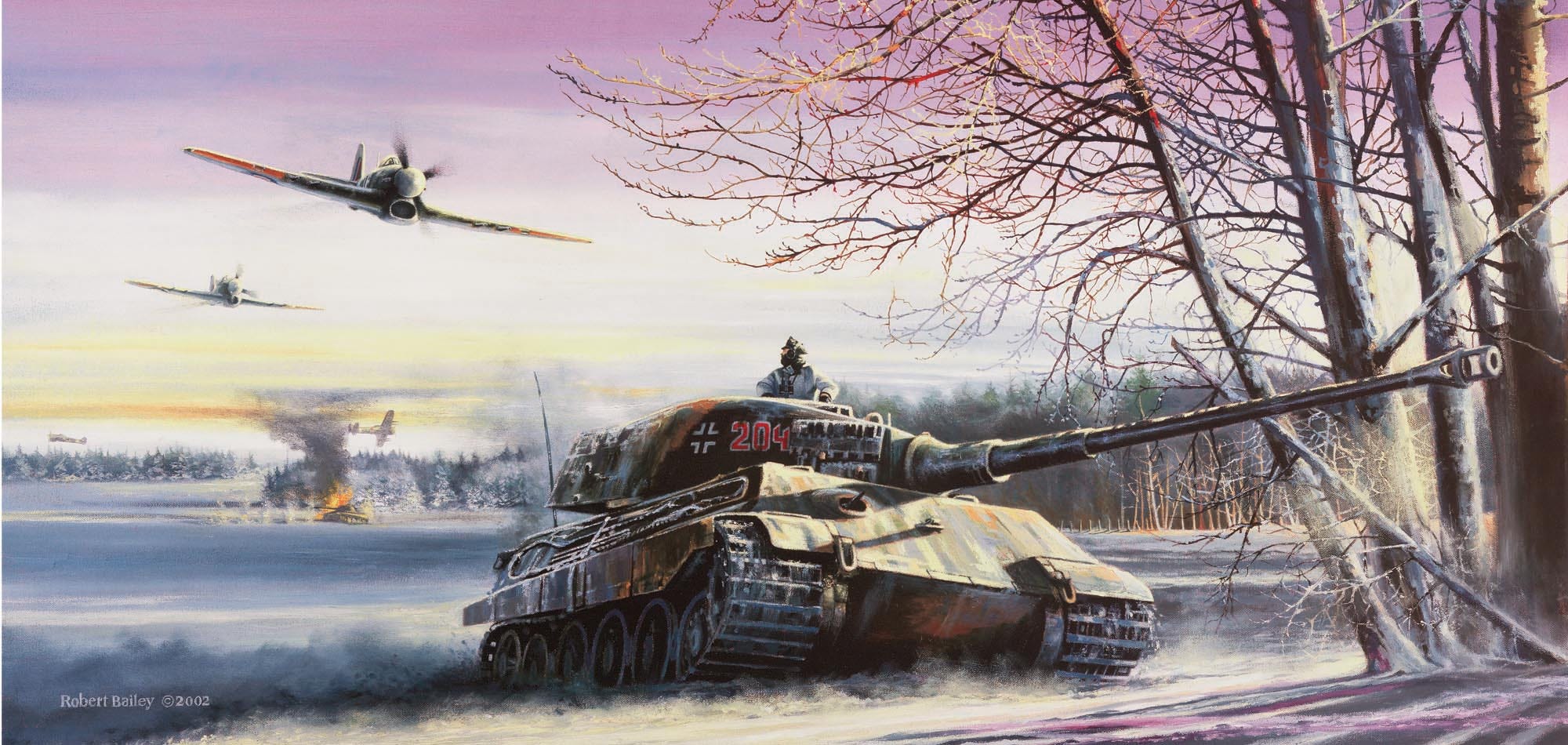
You don’t have to be the praying kind to call out for unearned help now and again. George Patton was notoriously profane and spared no blasphemy in his epic tirades. When he needed the weather to break for him during the Battle of the Bulge, he ordered his chaplain to compose a prayer and “get God working on our side.”
The act of weaponizing prayer demonstrates the absence of sufficiently authentic faith to believe it will work or deserve it to do so. And yet, it worked. The weather lifted, the siege was broken, and Patton gave his chaplain a Bronze Star.
Before our first mission over Afghanistan in October ‘01, the chaplain stood up in our planning cell and invited us to bow our heads as he delivered a prayer for our safe return. I joined my teammates in doing so.
I was not a holy man and felt a bit phony playing along. But it was the respectful and tolerant thing to do. Still, there was something else. It was an uncertain moment. We didn’t know beyond educated guesswork what we were flying into. Uncertainty creates vulnerability. So in that moment my mind was open. It didn’t cost me anything to retain, even in spiritual pessimism, the willingness to ask a stranger for help.
Appealing for the protection of whoever or whatever is watching over us or isn’t, even for those who eschew worship of supra-existential deities, has been a human habit since well before we had the ability to write it down.
This very morning, sitting in the quiet, I am once again challenged to settle in solitude. Again jostled by nervous dread and involuntary thoughts. And again pleading in silence for whatever help the cosmos can afford to make things turn out right.
As I write these words, there is an American airman missing in Southwestern Iran. An F-15E Strike Eagle was downed by enemy fire. Of its two crewmembers, one has been rescued. The other is unaccounted for. A bounty has been made payable. It feels grim.
Air Force flight crews are trained to survive and evade behind enemy lines. The training they receive is detailed, recurring, grounded in the lessons of previous real-world examples, and taught by some of the best survivalists on the planet. Airmen who operate the F-15E specialize in keeping their wits and executing with methodical precision while enveloped in chaos. So there is reason to harbor as much optimism as these facts permit.
Our joint military force is the best in the history of the world at bringing our people home alive in situations like this. Unmatched resources and training combine with a selfless spirit defined by fighting for the lives of teammates. In less than 24 hours, we’ve seen the rescue of two downed aircrew members and aggressive, never-say-die urgency to locate a third. So we can also be optimistic that if it can be done, these guys will do it.
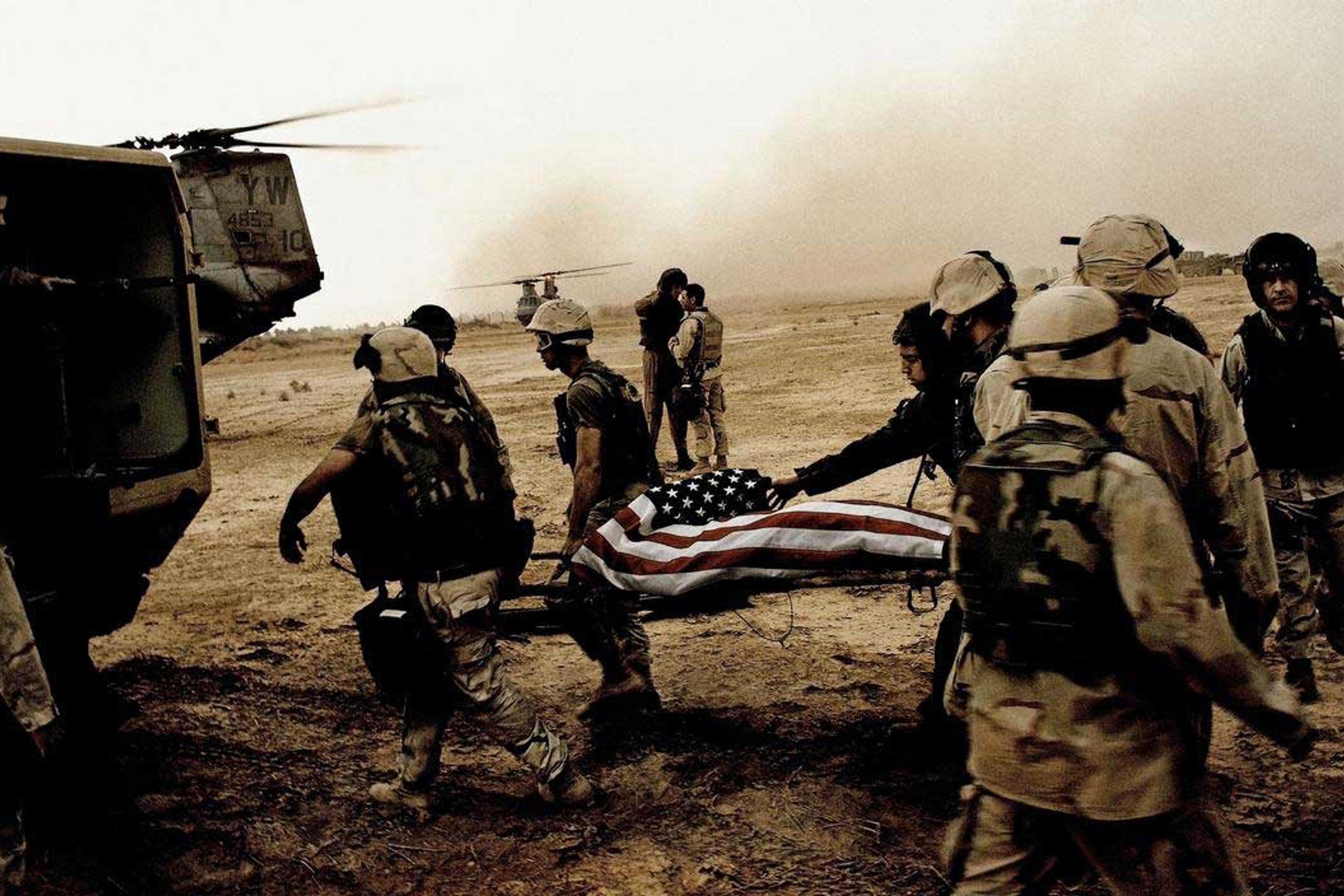
But it doesn’t take an elite empath to understand how the family, friends, and squadron mates of our missing airman must be feeling at this moment.
The entirety of Iran’s military command structure is focused on hunting for this individual. We cannot trust Iran’s leadership, much less the ordinary soldiers comprising its formations, to conduct themselves humanely or even lawfully in the event they locate our airman before we do.
There are a dozen ways this could play out. Most of them are not great to think about. So yeah. It’s one of those moments where I’m certain I’m not unique in the compulsion to look skyward and engage in some gentle groveling.
Because what I hope for is forgiveness, or at least a reprieve. Not for myself, but others.
So-called leaders so reckless and thoughtless that they have, by actions, words, and needless inflammations, made a dangerous moment more precarious. Not for themselves, but the very people they are meant to protect.
This, to me, is unforgivable. But if there is a God, I hope she forgives it. Or at the very least, delivers her wrath with precision and refrains from collective punishment.
III.
We need the temporary suspension of karma. For Murphy’s Law to be ruled unconstitutional. For what comes around to not yet go around.
Because if justice befalls us collectively at this moment, we’re in trouble. We’ve had an individual speaking and acting on our behalf whose actions reflect wickedness and moral rupture. Whose words tempt the abandonment of goodness.
For the past few weeks, we’ve watched Secretary of Defense Hegseth invoke a crusader’s language and tone in his public addresses. He’s framed this war as a struggle between religions rather than a campaign concerned with security or vital interests.
The framing he’s adopted will be convincing to the Iranian people in all the wrong ways. They will believe America isn’t at war with them for a specific purpose, like preventing a nuclear weapon or combating terrorism.
They will believe we want to kill them for who they are. That we want to extinguish their culture. Destroy the ideas and beliefs that define them as a civilization.
That kind of talk is off-the-scale reckless in the unprecedented extreme. It bears absolutely no likeness to any American tradition or value. It has no place in our conduct of international or defense affairs. It should have triggered hearings to debate removing him from his position, but the same people who put him there refuse to own their mistake.
And it pisses me off. Because it makes things a Hell of a lot more dangerous for those doing the fighting.
Religious conflict implicates irreconcilable differences in core beliefs. It immediately carries violence to a more intense and savage extreme because it is framed as a total stakes collision of not just belligerent states, but mortal enemies. The worst things humans have done to one another have happened under the banner of religious fanaticism.
And this guy, who became the official leader of our military by a single vote after his making his fortune using religious hot-button issues to stoke division and hate, is now working to convince our enemies that we’re not just there to do a job. We’re there because we hate them.
Easy for him to say as he luxuriates in swaddling clothes in an air conditioned office, his crusade fantasies only interrupted for whiskey refills and half-hourly cosmetic refreshes. And the occasional trip outside to kick a random puppy.
In the context of the noise Iranians will have heard from the US in recent times, especially given the propagandist filtration process between source and audience, Hegseth is confirming anti-American bias and validating Iranian fear.
No good will come of that, and if he was sparing even a rare thought for the risks faced by those in his alleged care, he’d stop being a prick and knock it off.
But, having never met a grenade he wouldn’t lob toward his own team, Hegseth recently doubled down.
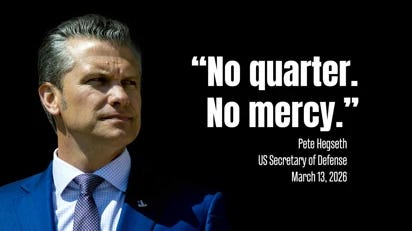
No quarter means no survivors. It means if you put your hands up and offer to surrender, you’ll be shot anyway. It means if you’re incapacitated, you will be executed.
Denial of quarter is a war crime. Threatening to deny quarter is a war crime. Declaring quarter will be denied is a war crime. These prohibitions have applied to the US military since President Lincoln signed the Lieber Code in 1863. They were later formalized in the Hague Conventions and Geneva Conventions.
The US Department of Defense Law of War Manual expresses legally binding limitations within which commanders at all levels must operate. Most of these are found in international law, expressed in treaties we’ve signed or customarily binding whether explicitly adopted or not.
Commanders are trained on its contents throughout their careers. Staff lawyers advise them on how to interpret and apply it.
A digression on why we have these limitations is not necessary. We have them. Whether Pete Hegseth buys into international law or doesn’t is as relevant as whether he likes comic books or plucking daisies. Laws bind him, and will do so until he is granted his deliverance.
When he stood in front of global microphone and threatened our Iranian adversaries with the denial of quarter, Pete Hegseth ignored his own manual. He committed a war crime by saying the words. It will be compounded if anyone is criminally dumb enough to listen to him.
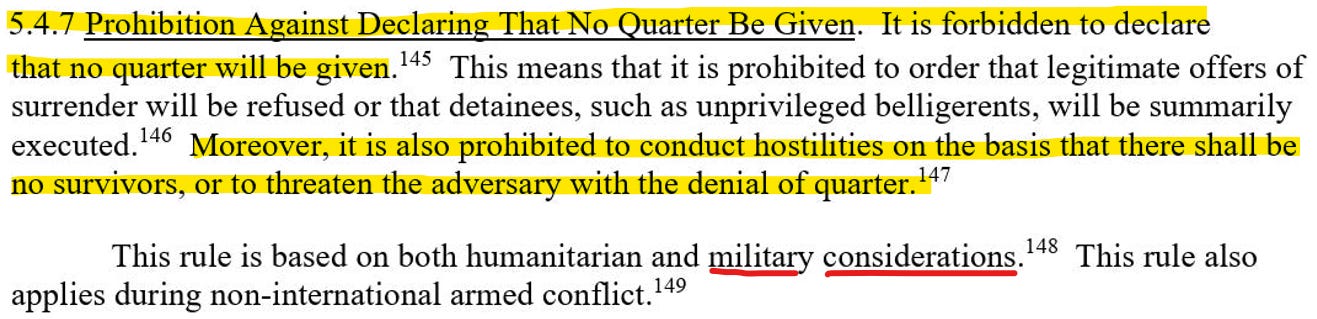
Now, you don’t need a legal scholar to understand what this says. You just need to be sober enough to read. You can keep eating your crayolas. It’s that clear.
Denial of quarter is such a grave breach that it occupies the very short list of things the whole world agrees are legally verboten, whether they are committed by a country that agreed to them or not. It is unlawful no matter the type of conflict, even if it’s against a non-state actor. We prosecuted Nazis at Nuremberg for refusing quarter.
Now our own Secretary of Defense is pretending it doesn’t apply to him. He might get away with that, at least for now. But someone else might pay the price.
Notice that bit I underlined in red. Military considerations.
Quarter is not just about being humane toward our enemies. It’s about self-interest. Because if they think we’re going to shoot anyone who surrenders, they have no incentive to lay down arms. They will fight to the death. This will cause us to bleed and suffer more. It’ll make war more costly in all dimensions.
They’ll also recognize that we’ve tossed aside the law of armed conflict, and will do the same themselves. Welcome to a world where anything goes. Torture, human shields, targeting non-combatants, and bombing hospitals.
In a world where anything goes, everything goes.
But here’s the kicker. It also means our people who are wounded will be killed rather than captured and given their rights under the Geneva Conventions.
And to bring this full circle, it means a downed airman who might have been captured in prior times is now more likely to be executed on the spot. It’s a nightmare to think about how much worse it could be than even that.
IV.
The people who fight for us are volunteers. But we should never take that for granted and never, ever weaponize it to shut down concerns about the moral fitness and competence of their leaders.
As I wrote not long ago, volunteers are entitled to assume certain things when they volunteer.
They assume high competence and good character in those entrusted with leading them.
They assume they’ll have strong and capable teammates to their left and right because we will maintain a high recruitment bar.
They assume they’ll have the best equipment and training money can buy, and be housed in liveable quarters while receiving reasonable pay.
They assume fairness. Respect. Decency.
And most of all, they assume the American people will never send them to war frivolously, or for the wrong reasons, or use them as a distraction from domestic political issues.
They are entitled to assume these things.
These days, these things cannot be assumed. If that doesn’t start reversing itself soon, we will have bigger problems than we can even imagine. Bigger problems than any volume of prayer can hope to answer.
I have no problem shouting into the sky and beg for help. I am doing that today.
But I do have a problem with reckless dilettantes faking it until they don’t make it as defense leaders, and in the process lacking the humility to channel wisdom, to develop temperance, and to learn and apply the prudence required to validate the trust placed in them by the best and bravest our nation has to offer.
I have a problem with Pete Hegseth bringing his personal beliefs and prayer traditions into the American military workplace.
But I have an even bigger problem with him making us reliant on prayers to bail us out of incompetence in service of moral oblivion. He’s demanding blind faith, we’re engaging in false hope, and meanwhile, the rational content of defense leadership is swirling a toilet bowl at the bottom of Hell.
Our problems are man-made, and usually self-inflicted. The solutions are human, and rational. We shouldn’t need divine help often, and shouldn’t feel desperate enough to beg for it.
We have Americans in harm’s way. We have an insane zealot zampolit at the controls making it more dangerous for them.
We wouldn’t need to pray so much if we just had good leadership.
But I won’t lie, I hope our prayers today will be answered. The alternative is more unthinkable to me than the inexistence of a God.
These are my thoughts about prayers on a day when I’m engaged in both.
Post-script: a few hours after this piece was published, we recovered our downed airman and brought him home safe and well. Thank God for the search and rescue teams who make the impossible look easy and achieve strategic impacts with the best tactical execution in the world.
Tony is an independent writer.
Insightful, exceptional writing.
Clear articulation of what most of us are feeling — thank you for putting it into words